Buy q-w.eu ?
We are moving the project
q-w.eu .
Are you interested in purchasing the domain
q-w.eu ?
domain@kv-gmbh.de · 0541-91531010
Buy q-w.eu ?
Which words end with a 'w'?
Some examples of words that end with a 'w' are: cow, bow, mellow, and below. These words all have the 'w' sound at the end of the word, giving them a distinct ending. **
Are foreign words stylistic devices?
Yes, foreign words can be considered stylistic devices as they can add a unique and exotic flair to a piece of writing. By incorporating foreign words, writers can convey specific cultural nuances or evoke certain emotions that may not be easily expressed in the writer's native language. However, it is important to use foreign words judiciously and ensure that they enhance the overall meaning and tone of the text rather than distract or confuse the reader. **


Similar search terms for Words
Top-Angebote
Products related to Words:
-
DK French for Everyone Junior 5 Words a Day: Learn and Practise 1,000 French WordsHelp your child master French vocabulary - five words at a time!Learn 1000 French words over a year with this French workbook for beginners! It's an essential vocabulary builder for young children who are starting to learn their first French words.Discover the perfect introduction to French for children aged 6-9. It's the ultimate French lesson for kids! It includes:- Beautifully illustrated scenes that teach and test five words at a time. New vocabulary is practised again at the end of each week in two pages of exercises- Clever flaps on the jacket that cover the scene so your child can practise what they have just learned- Uses the effective rote-learning method to teach new vocabulary- Teaches a range of nouns and verbs that are useful in everyday life; audio is available online and via a handy app to help with pronunciationThis unique French teaching guide contains everything your child needs to acquire a firm grasp of the French language in a fun and interactive way! Each week, 20 new words are presented over four days, and on the fifth day, your child can practise the words they have just learned. This will help them build up a vocabulary of more than 1000 French words over the course of a year!From animals and sports to colours and plants, French for Everyone Junior teaches a mix of nouns and verbs through stunning illustrations with each new word clearly labelled. This encourages young learners to memorise the words before covering them with the cleverly designed flaps and testing their new knowledge. Accompanying audio means that children can also practice their French pronunciation as many times as they want.The colourful, clear and comprehensive 5 Words a Day series from DK lays the foundations for your child's journey in learning a foreign language, at school or home. Look out for other workbooks in the series! Help your child learn, practise, and understand 1000 German words in German for Everyone Junior: 5 Words a Day.7,99 £*Shipping: 2,99 £Secure redirect to the provider
-
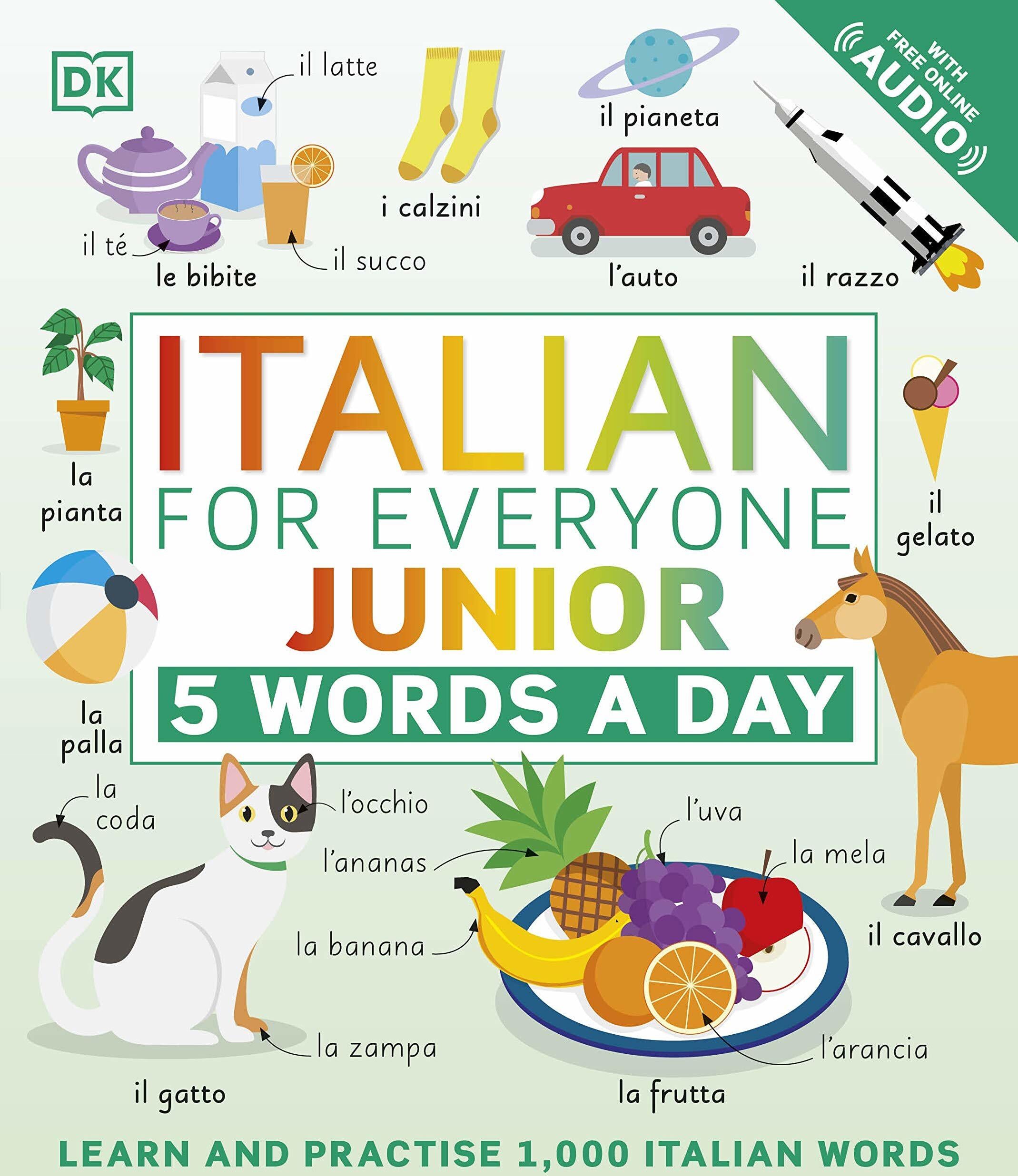
DK Italian for Everyone Junior 5 Words a Day: Learn and Practise 1,000 Italian WordsHelp your child master Italian vocabulary - five words at a time! Learn 1000 Italian words over a year with this Italian workbook for beginners! It's an essential vocabulary builder for young children who are starting to learn their first Italian words. Discover the perfect introduction to Italian for children aged 6-9. It's the ultimate Italian lesson book for kids! It includes: - Beautifully illustrated scenes that teach and test five words at a time. New vocabulary is practised again at the end of each week in two pages of exercises - Clever flaps on the jacket that cover the scene so your child can practise what they have just learned - Uses the effective rote-learning method to teach new vocabulary - Teaches a range of nouns and verbs that are useful in everyday life; audio is available online and via a handy app to help with pronunciation Learning a foreign language is one of the best ways to develop your child's cognitive and language abilities. What's more, children gain insight into other cultures and their linguistic nuances. This language book covers Italian vocabulary, Italian pronunciation and makes learning the first Italian words easy and fun. Illustrations, exciting scenes, and audio recordings allow your child to immerse themselves in their Italian language-learning journey fully! Italian Everyone Junior 5 Words a Day encourages children to copy the nouns and verbs related to each scene in the book, to test their knowledge by covering the words with jacket flaps, and learn one new Italian word every day.7,95 £*Shipping: 2,99 £Secure redirect to the provider
-
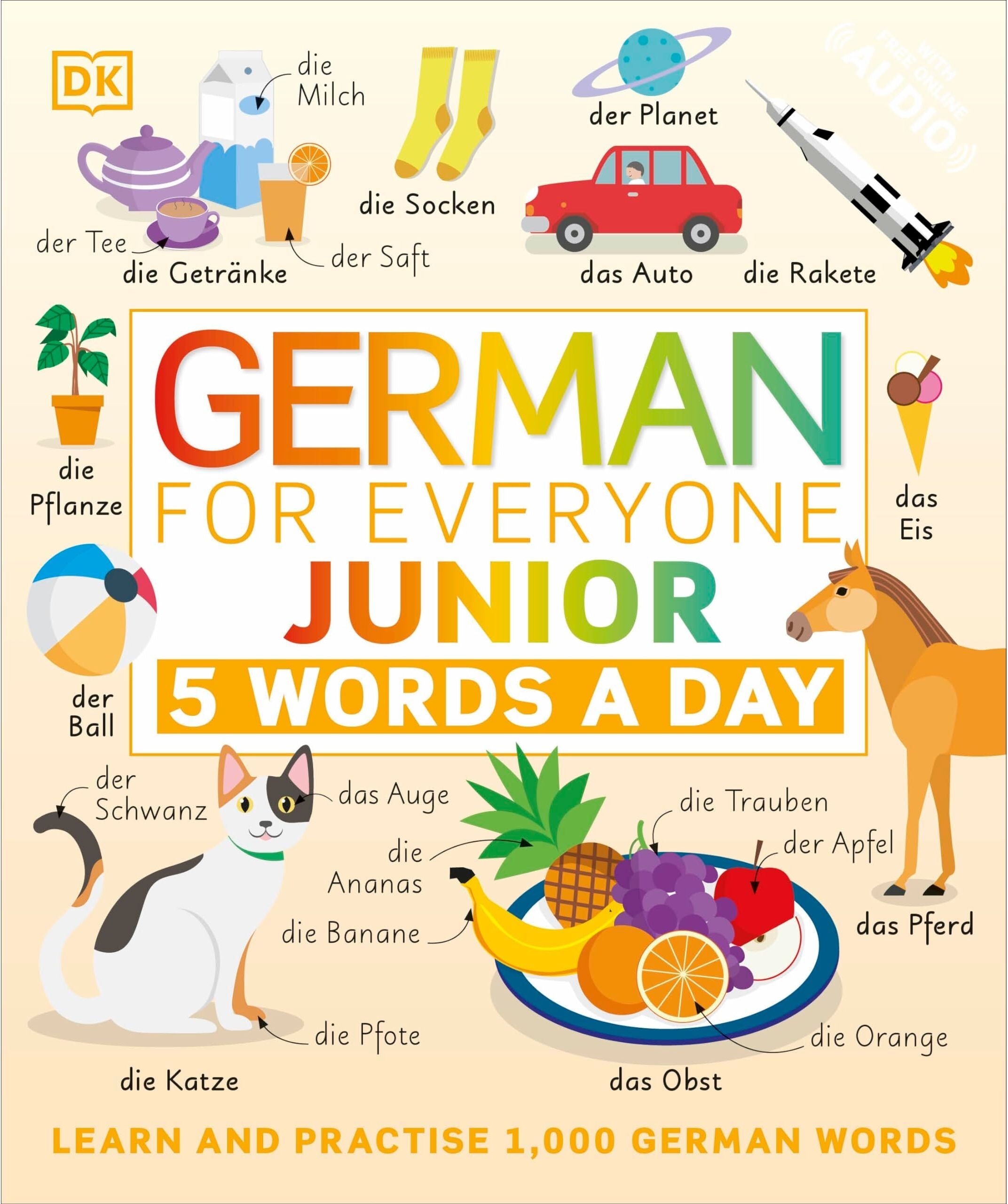
DK German for Everyone Junior 5 Words a Day: Learn and Practise 1,000 German WordsHelp your child master German vocabulary - five words at a time! Learn 1000 German words over a year with this German workbook for beginners! It's an essential vocabulary builder for young children who are starting to learn their first German words. Discover the perfect introduction to German for children aged 6-9. It's the ultimate German lesson for kids! It includes: - Beautifully illustrated scenes that teach and test five words at a time. New vocabulary is practised again at the end of each week in two pages of exercises - Clever flaps on the jacket that cover the scene so your child can practise what they have just learned - Uses the effective rote-learning method to teach new vocabulary - Teaches a range of nouns and verbs that are useful in everyday life; audio is available online and via a handy app to help with pronunciation This unique German teaching guide contains everything your child needs to acquire a firm grasp of the German language in a fun and interactive way! Each week, 20 new words are presented over four days, and on the fifth day, your child can practise the words they have just learned. This will help them build up a vocabulary of more than 1000 German words over the course of a year! From animals and sports to colours and plants, German for Everyone Junior teaches a mix of nouns and verbs through stunning illustrations with each new word clearly labelled. This encourages young learners to memorise the words before covering them with the cleverly designed flaps and testing their new knowledge. Accompanying audio means that children can also practice their German pronunciation as many times as they want.7,95 £*Shipping: 2,99 £Secure redirect to the provider
-
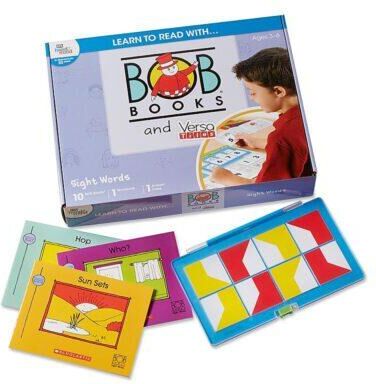
BOB Books VersaTiles Kit: Sight WordsBob Books offers repetition and fun stories to introduce important sight words. Consistent short vowels and simple stories ensure that each book is a gentle step into early reading.Alongside these books students can practice the skills they are...39,99 $*Shipping: 0,00 $Secure redirect to the provider

-
Why do all question words start with W?
Question words in English typically start with W because they are derived from Old English and Germanic languages, where many interrogative words also began with the letter W. This pattern has been maintained over time, and as English evolved, question words continued to start with W. This consistency helps learners and speakers of English easily recognize and remember these important words for asking questions. **
-
Which words are signal words?
Signal words are words that indicate a change in direction, emphasis, or relationship within a text. Examples of signal words include "however," "therefore," "in contrast," "on the other hand," and "conversely." These words help guide the reader through the structure of the text and highlight important transitions or connections between ideas. **
-
Are there words in which a q appears without a u?
Yes, there are words in which a "q" appears without a "u." These words are typically borrowed from other languages such as Arabic, Chinese, or Indigenous languages. Some examples of English words with a "q" but no "u" include "qat," "qaid," and "qabalah." These words are not very common in everyday English usage. **
-
Can you create five mnemonic devices with these vocabulary words?
Sure! Here are five mnemonic devices using the vocabulary words: 1. For the word "gregarious," you can remember it by thinking of a group of friends gathering in a "gregarious" manner. 2. To remember "ephemeral," think of a "femoral" artery that is temporary and fleeting. 3. For "ubiquitous," imagine something that is "everywhere" and "ubiquitous" like the air we breathe. 4. To recall "alacrity," picture someone showing enthusiasm and eagerness by saying "I'm ready with alacrity!" 5. For "sagacious," think of a wise old sage giving you advice, as someone who is sagacious is wise and knowledgeable. **

Are there any mnemonic devices for these Latin vocabulary words?
Yes, there are mnemonic devices that can be used to remember Latin vocabulary words. For example, for the word "amare" (to love), you can create a mnemonic by associating it with the English word "amorous." Another example is the word "laborare" (to work), which can be remembered by associating it with the English word "labor." Mnemonic devices can help to make the memorization of Latin vocabulary words more engaging and effective. **
Which English words sound like German words?
Some English words that sound like German words include "kindergarten," "angst," "delicatessen," and "poltergeist." These words have been borrowed from German and are commonly used in English with similar meanings. The similarity in sound is due to the shared Germanic roots of both languages. **
Top-Angebote
Products related to Words:
-
Uplift Treasures Positive Words Colorful Beaded Bracelet Set Positive Words Colorful Beaded Bracelet SetProduct Description: Brighten any outfit with this fun 12 piece beaded bracelet set featuring colorful candy inspired beads and uplifting word details. Perfect for stacking, sharing, or gifting, these cheerful bracelets add a playful touch to...52,97 $*Shipping: 0,00 $Secure redirect to the provider
-
Certified International Halloween Words MugsSomewhere between pouring the first October cup of coffee and surviving the post-trick-or-treat sugar crash, there is a mug that understands exactly what you are going through — and says so with the precision and honesty of a very good dictionary...32,44 $*Shipping: 0,00 $Secure redirect to the provider
-
DK French for Everyone Junior 5 Words a Day: Learn and Practise 1,000 French WordsHelp your child master French vocabulary - five words at a time!Learn 1000 French words over a year with this French workbook for beginners! It's an essential vocabulary builder for young children who are starting to learn their first French words.Discover the perfect introduction to French for children aged 6-9. It's the ultimate French lesson for kids! It includes:- Beautifully illustrated scenes that teach and test five words at a time. New vocabulary is practised again at the end of each week in two pages of exercises- Clever flaps on the jacket that cover the scene so your child can practise what they have just learned- Uses the effective rote-learning method to teach new vocabulary- Teaches a range of nouns and verbs that are useful in everyday life; audio is available online and via a handy app to help with pronunciationThis unique French teaching guide contains everything your child needs to acquire a firm grasp of the French language in a fun and interactive way! Each week, 20 new words are presented over four days, and on the fifth day, your child can practise the words they have just learned. This will help them build up a vocabulary of more than 1000 French words over the course of a year!From animals and sports to colours and plants, French for Everyone Junior teaches a mix of nouns and verbs through stunning illustrations with each new word clearly labelled. This encourages young learners to memorise the words before covering them with the cleverly designed flaps and testing their new knowledge. Accompanying audio means that children can also practice their French pronunciation as many times as they want.The colourful, clear and comprehensive 5 Words a Day series from DK lays the foundations for your child's journey in learning a foreign language, at school or home. Look out for other workbooks in the series! Help your child learn, practise, and understand 1000 German words in German for Everyone Junior: 5 Words a Day.7,99 £*Shipping: 2,99 £Secure redirect to the provider
-
DK Italian for Everyone Junior 5 Words a Day: Learn and Practise 1,000 Italian WordsHelp your child master Italian vocabulary - five words at a time! Learn 1000 Italian words over a year with this Italian workbook for beginners! It's an essential vocabulary builder for young children who are starting to learn their first Italian words. Discover the perfect introduction to Italian for children aged 6-9. It's the ultimate Italian lesson book for kids! It includes: - Beautifully illustrated scenes that teach and test five words at a time. New vocabulary is practised again at the end of each week in two pages of exercises - Clever flaps on the jacket that cover the scene so your child can practise what they have just learned - Uses the effective rote-learning method to teach new vocabulary - Teaches a range of nouns and verbs that are useful in everyday life; audio is available online and via a handy app to help with pronunciation Learning a foreign language is one of the best ways to develop your child's cognitive and language abilities. What's more, children gain insight into other cultures and their linguistic nuances. This language book covers Italian vocabulary, Italian pronunciation and makes learning the first Italian words easy and fun. Illustrations, exciting scenes, and audio recordings allow your child to immerse themselves in their Italian language-learning journey fully! Italian Everyone Junior 5 Words a Day encourages children to copy the nouns and verbs related to each scene in the book, to test their knowledge by covering the words with jacket flaps, and learn one new Italian word every day.7,95 £*Shipping: 2,99 £Secure redirect to the provider
-
Which words end with a 'w'?
Some examples of words that end with a 'w' are: cow, bow, mellow, and below. These words all have the 'w' sound at the end of the word, giving them a distinct ending. **
-
Are foreign words stylistic devices?
Yes, foreign words can be considered stylistic devices as they can add a unique and exotic flair to a piece of writing. By incorporating foreign words, writers can convey specific cultural nuances or evoke certain emotions that may not be easily expressed in the writer's native language. However, it is important to use foreign words judiciously and ensure that they enhance the overall meaning and tone of the text rather than distract or confuse the reader. **
-
Why do all question words start with W?
Question words in English typically start with W because they are derived from Old English and Germanic languages, where many interrogative words also began with the letter W. This pattern has been maintained over time, and as English evolved, question words continued to start with W. This consistency helps learners and speakers of English easily recognize and remember these important words for asking questions. **
-
Which words are signal words?
Signal words are words that indicate a change in direction, emphasis, or relationship within a text. Examples of signal words include "however," "therefore," "in contrast," "on the other hand," and "conversely." These words help guide the reader through the structure of the text and highlight important transitions or connections between ideas. **
Similar search terms for Words
-
DK German for Everyone Junior 5 Words a Day: Learn and Practise 1,000 German WordsHelp your child master German vocabulary - five words at a time! Learn 1000 German words over a year with this German workbook for beginners! It's an essential vocabulary builder for young children who are starting to learn their first German words. Discover the perfect introduction to German for children aged 6-9. It's the ultimate German lesson for kids! It includes: - Beautifully illustrated scenes that teach and test five words at a time. New vocabulary is practised again at the end of each week in two pages of exercises - Clever flaps on the jacket that cover the scene so your child can practise what they have just learned - Uses the effective rote-learning method to teach new vocabulary - Teaches a range of nouns and verbs that are useful in everyday life; audio is available online and via a handy app to help with pronunciation This unique German teaching guide contains everything your child needs to acquire a firm grasp of the German language in a fun and interactive way! Each week, 20 new words are presented over four days, and on the fifth day, your child can practise the words they have just learned. This will help them build up a vocabulary of more than 1000 German words over the course of a year! From animals and sports to colours and plants, German for Everyone Junior teaches a mix of nouns and verbs through stunning illustrations with each new word clearly labelled. This encourages young learners to memorise the words before covering them with the cleverly designed flaps and testing their new knowledge. Accompanying audio means that children can also practice their German pronunciation as many times as they want.7,95 £*Shipping: 2,99 £Secure redirect to the provider
-
BOB Books VersaTiles Kit: Sight WordsBob Books offers repetition and fun stories to introduce important sight words. Consistent short vowels and simple stories ensure that each book is a gentle step into early reading.Alongside these books students can practice the skills they are...39,99 $*Shipping: 0,00 $Secure redirect to the provider
-
"Certified International Halloween Words Salad Plate 8.25"""Halloween is a beautiful holiday that is also, occasionally, a lot. The sugar highs. The post-trick-or-treat negotiations. The firmly held belief that granola bars are acceptable candy.36,34 $*Shipping: 0,00 $Secure redirect to the provider
-
Are there words in which a q appears without a u?
Yes, there are words in which a "q" appears without a "u." These words are typically borrowed from other languages such as Arabic, Chinese, or Indigenous languages. Some examples of English words with a "q" but no "u" include "qat," "qaid," and "qabalah." These words are not very common in everyday English usage. **
-
Can you create five mnemonic devices with these vocabulary words?
Sure! Here are five mnemonic devices using the vocabulary words: 1. For the word "gregarious," you can remember it by thinking of a group of friends gathering in a "gregarious" manner. 2. To remember "ephemeral," think of a "femoral" artery that is temporary and fleeting. 3. For "ubiquitous," imagine something that is "everywhere" and "ubiquitous" like the air we breathe. 4. To recall "alacrity," picture someone showing enthusiasm and eagerness by saying "I'm ready with alacrity!" 5. For "sagacious," think of a wise old sage giving you advice, as someone who is sagacious is wise and knowledgeable. **
-
Are there any mnemonic devices for these Latin vocabulary words?
Yes, there are mnemonic devices that can be used to remember Latin vocabulary words. For example, for the word "amare" (to love), you can create a mnemonic by associating it with the English word "amorous." Another example is the word "laborare" (to work), which can be remembered by associating it with the English word "labor." Mnemonic devices can help to make the memorization of Latin vocabulary words more engaging and effective. **
-
Which English words sound like German words?
Some English words that sound like German words include "kindergarten," "angst," "delicatessen," and "poltergeist." These words have been borrowed from German and are commonly used in English with similar meanings. The similarity in sound is due to the shared Germanic roots of both languages. **
* All prices are inclusive of VAT and, if applicable, plus shipping costs. The offer information is based on the details provided by the respective shop and is updated through automated processes. Real-time updates do not occur, so deviations can occur in individual cases. ** Note: Parts of this content were created by AI.